
The case for translating policy into communication that people will actually use
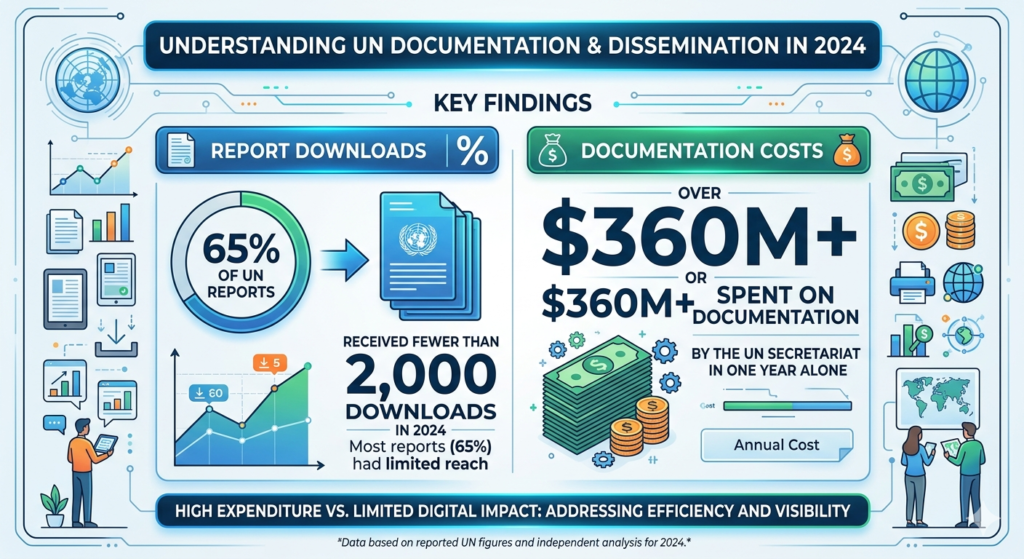
In a 2025 briefing to UN Member States, Secretary-General Antonio Guterres presented findings that should trouble every institution that produces research, policy documents, or public interest reports. Of the more than 1,100 reports produced by the UN Secretariat in 2024, nearly 65% were downloaded fewer than 2,000 times. One in ten received fewer than 1,000 downloads. The UN spent over $360 million that year on documentation services alone, not counting the cost of drafting, clearance, and publication.
The Secretary-General acknowledged the obvious: downloading a report does not mean reading it. The organisation, producing over 27,000 supported meetings annually, across 240 different bodies, was generating enormous volumes of knowledge that was not reaching its intended audiences at anything close to the scale the investment deserved.
This is not a problem unique to the United Nations. It is structural, and it is widespread.
Let’s bring it close to home. In 2024, the Nigerian Economic Summit Group (NESG) released the Status of Food Security: Dimensioning the Crisis, Policy Options, and Strategic Responses policy brief. While the brief received significant press pickup from Tier-1 Nigerian media outlets and minimal press pickup internationally, nearly two years have passed without the recommendations of the policy brief being fully adopted or cascaded to the intended front players.
The Knowledge-to-Impact Gap
Research institutions, university departments, corporate foundations, and non-profit organisations face the same challenge in a different context. A whitepaper gets commissioned, drafted, reviewed, and published. A policy brief is submitted to a government committee. A clinical study is added to a journal database. An impact report is filed with a donor. The internal box is ticked. But the people whose behaviour or decisions the document was meant to influence, whether a smallholder farmer in Benue State, a hospital administrator in Kano, or a procurement director in Lagos, never encounter it. The document exists. The change it intended does not.
The reasons are consistent across sectors. Technical documents are written for technical audiences, using the language of the field rather than the language of the end user. The communication strategy, where one exists at all, stops at distribution: publishing a link, sending a PDF to a mailing list, issuing a press release that gets three column inches in a newspaper. The result is a significant and growing gap between the volume of knowledge being produced and the volume of knowledge being absorbed and acted upon.
For Businesses and Non-Profits, the Stakes Are Higher
Commercial organisations have long understood this. A company that publishes a thought leadership report without a distribution and engagement strategy is leaving brand equity and market influence on the table. But for non-profit organisations, development agencies, and public research institutions, the cost is measured differently. Impact that is not communicated is not only invisible to the public; it is invisible to funders, to policymakers, and to the communities the organisation exists to serve.
Consider the disproportion: organisations that successfully communicate their work attract sustained investment, influence policy agendas, and shape the vocabulary through which entire sectors are understood. Organisations that produce equivalent or superior work but communicate it poorly remain peripheral to those conversations, regardless of the quality of their output. The research budget gets renewed. The communications budget does not get built.
Translation Is a Strategic Discipline
The solution is not to simplify the work. It is to build a second discipline alongside it: the deliberate translation of research findings and policy positions into communications that the intended beneficiaries can understand, trust, and act on. This means investing in clear-language summaries, audience-segmented messaging, media engagement, and sustained narrative management, not as an afterthought to research production, but as a parallel process with its own strategy, resources, and performance metrics.
If the work is worth doing, it is worth being known. The UN’s own data makes the case that even the most well-resourced institutions in the world get this wrong at scale. For every organisation that cannot yet afford to get it wrong, the question is simpler and more urgent: who is reading your work, and what are they doing differently because of it?
That is the conversation we are here to have.
If your non-profit has been doing tremendous work to shape policies, producing briefs and white papers, yet struggles to see the desired potential change in the landscape based on your recommendation, do not hesitate to contact us at [email protected].
We are always ready to partner with you.
Till next time,
Keep communicating,
Tolulope Olorundero